The Paperwork That Decides Whether You Can Actually Buy at Venus on Okaloosa Island
August 13, 2026
August 13, 2026
If a condo built in 1973 looks priced right, sits diagonally across from public beach access on Santa Rosa Boulevard, and comes with a pool, a lighted tennis court, and a shuffleboard court that has clearly hosted forty years of family vacations, what's actually left to worry about?
The answer isn't the building's age. It's whether the paperwork behind that age already exists, and whether it says what a lender needs it to say.
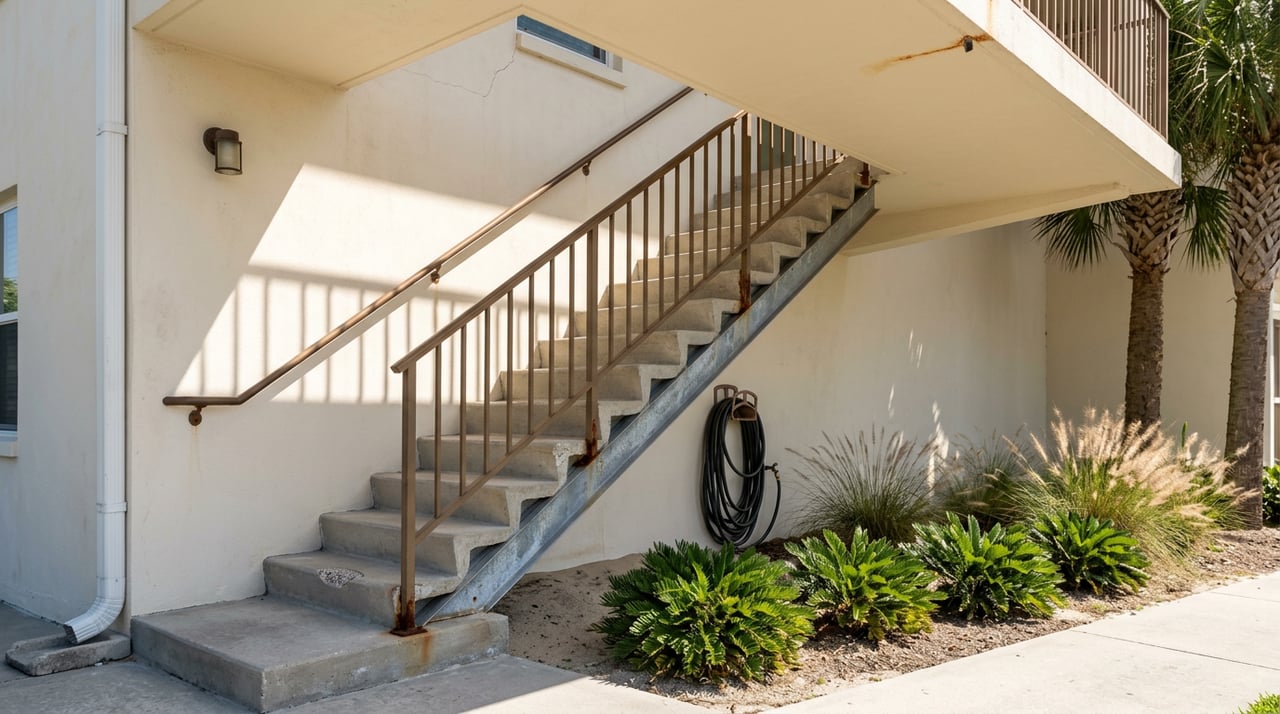
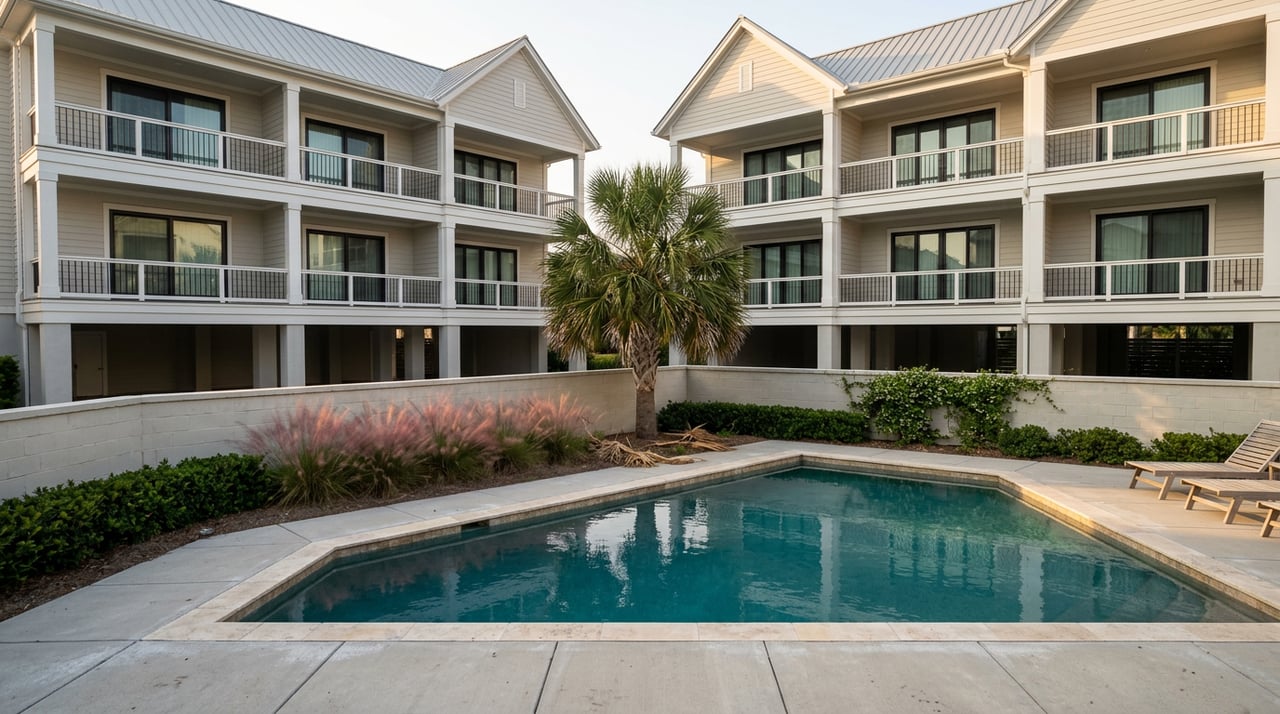
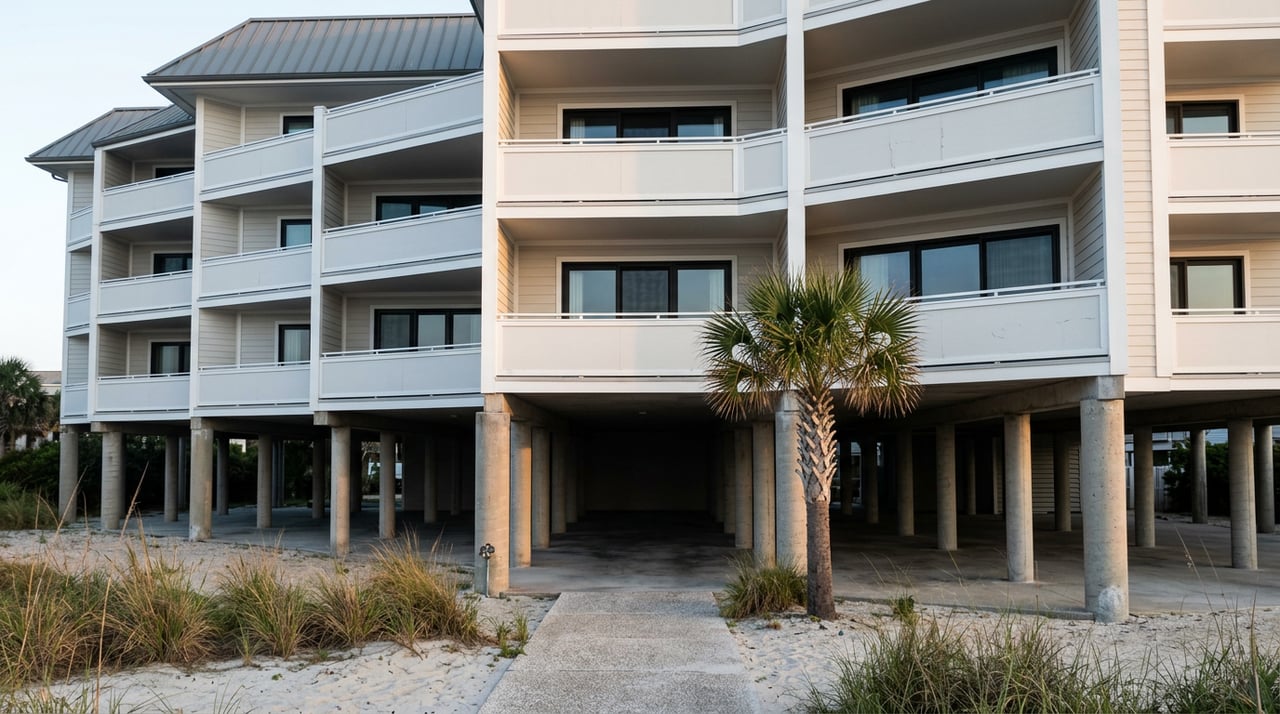
Venus Condominiums, the 44-unit community tucked behind Bella Riva and Pelican Isle on South Okaloosa Island, is exactly the kind of building where this question matters. Four three-story buildings wrap around a shared courtyard and pool. Units run from one-bedroom layouts to three-bedroom floor plans, and the whole property sits an easy walk from the Emerald Promenade Beach Walk, the Boardwalk, the Okaloosa Island Fishing Pier, and the Gulfarium. It's the kind of unpretentious, old-Florida complex people fall for immediately. It's also 53 years old in 2026, which means it doesn't get to opt out of a state law that has quietly rewritten what "buying an older condo" means in Florida.
Florida's milestone inspection law, Florida Statute 553.899, requires condominium and cooperative buildings with three or more habitable stories to undergo a structural inspection once they reach a set age, then again every ten years after that. Buildings within three miles of the coastline hit that first trigger at 25 years. Buildings farther inland get until 30. The law traces back to Senate Bill 4-D, signed in 2022 in the wake of the Champlain Towers South collapse in Surfside.
Here's the part that matters for a building like Venus. The law didn't wait for buildings to turn the trigger age after 2022. It looked at buildings that had already blown past 25 or 30 years by the time the statute took effect and gave them a catch-up deadline of their own. According to guidance published for Okaloosa County associations, buildings that were already over the age threshold when the law passed faced an initial milestone inspection deadline of December 31, 2024, a date one local engineering firm was still flagging as urgent for Okaloosa County properties as recently as October 2024.
Venus was already 49 years old when SB 4-D became law. It didn't get a grace period. It landed straight into that earliest bucket, with a deadline that has now been in the rearview mirror for well over a year and a half. If you're looking at a unit here, the first question isn't "how old is the building." It's "where's the Phase 1 report, and what date is on it."
It would be easy to assume milestone inspections are a box-checking exercise most buildings pass without incident. Okaloosa County's own inspection data says otherwise.
A state legislative review published in July 2026 named Okaloosa County among the handful of Florida counties reporting the highest number of buildings that required a Phase Two inspection in 2025, alongside Pinellas, Santa Rosa, and Walton counties. Phase Two isn't triggered automatically. It only kicks in when a licensed engineer's initial visual review finds substantial structural deterioration serious enough to warrant destructive and non-destructive testing. A county showing up on that list means a meaningful share of its older beachfront buildings are surfacing real issues, not just paperwork.
That context changes what "ask for the inspection report" actually means for a buyer. It's not a formality question. It's a real one, with real odds attached, specific to the county Venus sits in.
| Step | What It Involves | Typical Cost | Deadline |
|---|---|---|---|
| Phase 1 | Visual structural review by a licensed engineer or architect | $8,000–$25,000 for smaller buildings | Due at the applicable age trigger, then every 10 years |
| Phase 2 (if triggered) | Destructive and non-destructive testing to confirm deterioration | $40,000–$250,000 or more | Repairs must begin within 365 days of the report |
| SIRS | Reserve study covering eight structural components (roof, load-bearing structure, waterproofing, electrical, plumbing, fire protection, windows and doors, and items exceeding $25,000) | Often bundled with the milestone engagement | Existing associations: December 31, 2025, or December 31, 2026 if paired with a milestone inspection due that year |
Because Venus's milestone deadline fell in the earlier 2024 bucket, its Structural Integrity Reserve Study would have followed the general December 31, 2025 deadline for existing owner-controlled associations, not the later 2026 window available to buildings whose milestone inspection is only now coming due. That distinction matters because Florida law no longer lets associations waive reserve funding for those eight structural components on any budget adopted after December 31, 2024, and full funding was required to start by January 1, 2026.
There's another wrinkle specific to a property shaped like Venus. The Florida Department of Business and Professional Regulation's inspection guidance describes milestone inspections as applying to individual buildings, not entire associations. Venus is four separate three-story buildings around one pool, each its own structure with its own certificate of occupancy. Ask specifically which of the four buildings holds the unit you're considering, and whether that building's inspection, not just "the community's," is current.
Milestone and SIRS status don't just affect the HOA's budget. They affect whether you can get a loan at all.
Fannie Mae maintains a project eligibility status for condo buildings, and as of August 2025, only about 3.6% of projects nationwide carried an "ineligible" designation. The top two reasons a project lands there are insufficient master property insurance and critical repair issues, including a failure to meet state or local inspection requirements. Florida punches well above its national share on this list. A dataset obtained by a Boston law firm and reported by the Wall Street Journal in March 2025 found 1,438 Florida condo and HOA communities on Fannie Mae's ineligible list out of roughly 5,175 nationwide, close to 28% of the total from a state that holds nowhere near 28% of the country's condos.
If a building carries that status, conventional financing backed by Fannie Mae or Freddie Mac isn't available on it. Buyers get pushed toward cash purchases or portfolio lenders, the buyer pool shrinks, and resale values tend to follow. Before writing an offer at Venus or any comparable building, a buyer's agent or lender can run the property through Fannie Mae's Condo Status Finder and should also request the last 12 months of board meeting minutes, looking specifically for any mention of upcoming special assessments.
There's a temptation to compare a legacy building like Venus to newer Gulf-front resort towers purely on price per square foot. That comparison leaves out the part of the ledger that's changing fastest.
A building that's still catching up on reserve funding for eight now-unwaivable structural components, on a schedule the state locked in starting January 1, 2026, is a building whose dues have room to move upward independent of anything happening to the unit itself. A lower purchase price at a place like Venus can look like savings today and get absorbed by a dues increase eighteen months from now if the reserve funding plan isn't already sound.
None of this means an older Okaloosa Island condo is a bad buy. It means the due diligence looks different than it did five years ago, and the buildings that have already done the work, filed the reports, and funded the reserves are worth more than their listing price alone would suggest.
If Venus had a Phase 2 finding, does that mean I shouldn't buy there? Not necessarily. A Phase 2 finding means repairs get scoped, permitted, and funded on a legally mandated timeline. Plenty of buildings pass through that process and remain sound long-term investments. It changes the price and timeline conversation more than it changes whether the purchase makes sense.
How do I actually get a copy of the milestone inspection report for a specific building? According to FirstService Residential, under current Florida law, the report must be filed with the local building department, in this case Okaloosa County's Growth Management office, and the association is required to post it on its own website and distribute the inspector's summary to owners. Ask the HOA or listing agent for the document directly rather than relying on secondhand summaries.
Can I still get a conventional mortgage on a condo like this? Yes, as long as the building isn't currently flagged on Fannie Mae's or Freddie Mac's ineligible lists. That status can change as inspections and reserve studies are completed, so checking it close to your offer date matters more than checking it once early in the search.
Buying an older Okaloosa Island condo isn't about avoiding buildings with history. It's about knowing exactly which chapter of Florida's new inspection law a specific building is in before you sign anything. If you're weighing a unit at Venus or anywhere else on the island and want someone to pull the actual reports before you write an offer, the Chris Carter Team has spent years working these transactions and can walk the paperwork with you line by line.
This article is general information, not legal, tax or financial advice. Consult a qualified professional about your situation.
Stay up to date on the latest real estate trends.
Ready to embark on a rewarding career journey in real estate? Contact us today to explore exciting opportunities with The Chris Carter Team. Your future in real estate starts here! Contact us today to find out how we can be of assistance to you!