The 30-Unit Paradox: What Summerlin Reveals About Boutique Condo Costs on Okaloosa Island in 2026
September 3, 2026
September 3, 2026
Why would an insurance underwriter in 2026 rather write a policy on a 30-unit building than a 250-unit resort tower next door? That question sounds backward. Bigger buildings are supposed to spread risk and cost across more owners, which should make them the safer, cheaper bet. On Okaloosa Island right now, the math runs the other way for at least half the equation, and the other half punishes the same small buildings the insurance market suddenly likes.
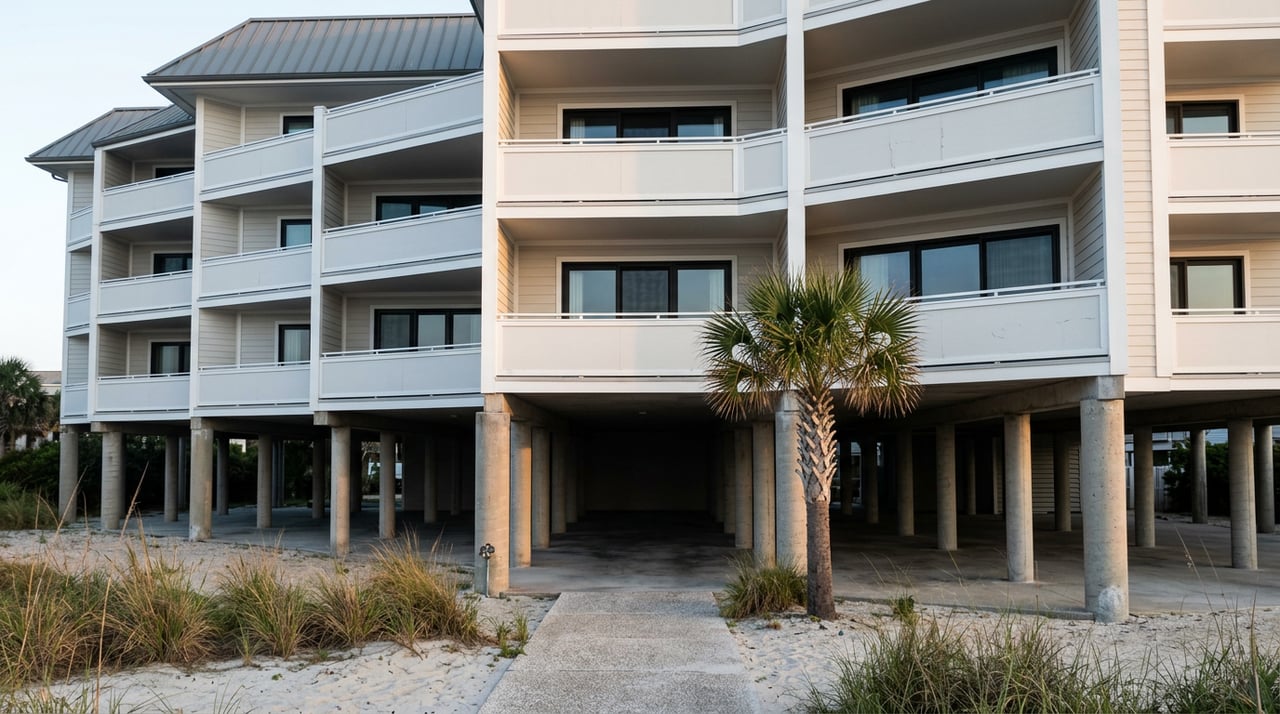
Summerlin sits in the middle of that contradiction. It is a 30-unit building on 200 feet of Gulf-front beach, built in 1998, on an island where local height limits cap every building at seven stories, so nothing here reads as a high-rise. It is the kind of intimate, well-kept property that gets voted the most attractive building on the island in vacation rental listings. It is also, by pure coincidence of unit count, close to the exact size that Florida condo insurance analysts are using in 2026 as their model example for a market shift most buyers have not caught up to yet.
Florida's condo insurance market spent years punishing everything on the coast equally. That is changing in 2026, but not evenly. Risk advisory firms tracking the state's carrier appetite this year describe a 30-unit boutique condo with roughly a 12 million dollar dwelling value as sitting comfortably within the underwriting authority of newly admitted carriers, while a 250 million dollar oceanfront tower still requires layered facultative reinsurance to get covered at all. A building the size of Summerlin, with documented hurricane strapping, a hip roof, and impact-rated openings, can qualify for premium credits of 15 to 40 percent off the windstorm portion of its policy. Underwriters are also reading small associations as a cleaner claims profile, since shorter histories and tighter board governance signal lower future loss volatility than a sprawling resort with hundreds of units and years of claims data behind it.
That is a real advantage, and it is new. For most of the post-Hurricane Michael decade, Panhandle coastal buildings of every size paid a premium simply for existing on the Gulf. Okaloosa County homeowners insurance averaged around 3,794 dollars a year in 2026, well above the roughly 2,100 dollar national average, and any beachfront property paid more on top of that county baseline. What has shifted is that carriers are now differentiating inside that coastal category, and a well-mitigated small building is starting to look like the better bet, not the riskier one.
Here is where the advantage runs into a wall. Since the Surfside collapse, Florida law has required condominiums three stories or taller to complete a Structural Integrity Reserve Study and, once they hit 30 years of age inland or 25 years within three miles of the coast, a milestone inspection. Summerlin, at 28 years old and sitting directly on the Gulf, falls squarely into that coastal trigger rather than the more forgiving inland one.
The engineering cost of meeting those requirements does not scale down with the building. Reserve study fees in 2025 ran roughly 8,000 to 25,000 dollars per building, driven mostly by mobilization and inspection time rather than square footage or unit count. Milestone inspections add another 4,000 to 15,000 dollars. A 30-unit building and a 250-unit building doing the same required scope of work face nearly the same invoice. The difference is how many owners split it.
| 30-unit building (Summerlin's size) | 250-unit resort tower | |
|---|---|---|
| Combined SIRS + milestone inspection cost | $12,000 to $40,000 total | $12,000 to $40,000 total |
| Cost per unit | roughly $400 to $1,333 | roughly $48 to $160 |
| 2026 insurance underwriting position | Favored: fits comfortably within admitted carrier capacity, often qualifies for wind mitigation credits | Requires layered reinsurance due to high total insured value |
That per-unit spread is the number that does not show up on a listing sheet. A buyer comparing HOA dues at a boutique building against a mega-resort is often comparing two different cost structures wearing the same monthly number. The boutique building may win on insurance rate per dollar of coverage and still lose on the compliance line item, because 30 owners are absorbing a bill that 250 owners barely notice.
Buyers now have a way to check where a building stands on both sides of this ledger before they write an offer, and that tool is only months old. As of January 1, 2026, Florida law requires condo associations with 25 or more units to post their governing documents, budgets, and reserve studies through a dedicated website or app, and owners now have a legal right to view completed SIRS and milestone reports within 30 days of their completion. The same broader legal shift ended the grace period on reserve waivers. Boards subject to a SIRS can no longer vote to underfund the structural components it covers, and by January 2026 that change had already started landing as real bills, since the earliest budgets built without a waiver option were only a cycle or two old at buildings that spent decades keeping dues artificially low.
That transparency requirement matters more at a building Summerlin's size than at a large one, because the dollar swing per owner is bigger. If a board has been slow to complete its milestone inspection or fund its reserves, that gap will show up faster and hit harder in a 30-unit association than in a 250-unit one, and it will now be visible online before you ever request a resale package.
At a building like Summerlin, the standard closing paperwork is not enough. Ask specifically for the milestone inspection summary and the current Structural Integrity Reserve Study, not just the annual budget. Ask when the association's certificate of occupancy dates from, since that date, not the year the association was formed, is what starts the inspection clock under Florida law. Ask what percentage of the SIRS-recommended reserve target the association is currently funding. A low percentage is not automatically disqualifying, but it tells you how close the next special assessment vote might be.
Florida condo owners have been getting real special assessment bills in 2026 as that grace period ended, with reported amounts running from around ten thousand dollars to well over one hundred thousand dollars per unit depending on the scope of deferred work. A building that has already completed its inspection and is funding reserves at target is a very different purchase than one that has not, even if both list at the same price per square foot.
The instinct to assume a larger resort building is the safer financial bet on the Gulf is understandable and, in 2026, only half right. The insurance side of the ledger has genuinely tilted toward small, documented, well-mitigated buildings like Summerlin. The compliance side has not caught up, and it will not, because engineering firms charge by the inspection, not by the door count. The real dividing line on Okaloosa Island this year is not building size. It is whether the board has already done the paperwork the state now requires, and whether that paperwork is something you can actually see before you sign a contract.
What is the difference between a milestone inspection and a Structural Integrity Reserve Study? A milestone inspection is a one-time structural safety check performed by a licensed engineer or architect at the 25 or 30 year mark and every 10 years after. A SIRS is a budget-planning study that identifies specific structural components, such as the roof, load-bearing walls, and plumbing, and sets the funding schedule required to maintain them. Buildings three stories or higher need both.
Does every gulf-front building on Okaloosa Island fall under the 25-year trigger instead of 30? The coastal trigger applies to qualifying buildings within three miles of the coastline. A beachfront building like Summerlin falls under that earlier timeline. A building further inland on the same island could still fall under the 30-year rule depending on its exact location.
Can I see a building's reserve funding status before I make an offer? As of January 1, 2026, associations with 25 or more units are required to post governing documents, budgets, and reserve studies through a website or app, and owners have a legal right to view completed SIRS and milestone reports within 30 days of completion. Ask your agent to pull this before you write.
If you are weighing a boutique building against a big resort on Okaloosa Island, the sticker price and the dues sheet only tell half the story. The Chris Carter Team can pull the actual reserve funding, inspection status, and insurance history on any building you're considering, so you know what you're really signing up for before you write the offer. Get Your Free Home Valuation to start the conversation.
Stay up to date on the latest real estate trends.
Ready to embark on a rewarding career journey in real estate? Contact us today to explore exciting opportunities with The Chris Carter Team. Your future in real estate starts here! Contact us today to find out how we can be of assistance to you!